


Every Kung Fu lesson in China begins and ends with the same gesture: the right hand makes a fist, the open left hand covers it, both in front of the chest. This is the Kung Fu salute, in Chinese 抱拳礼 (bàoquán lǐ), the fist-and-palm salute. It looks simple, but every detail has a meaning: the fist, the open palm, the bent thumb, even the round shape of the arms. In this article you learn how to do the salute correctly, what each part means, where it comes from, how it differs from the everyday Chinese greeting and when it is used at our school.

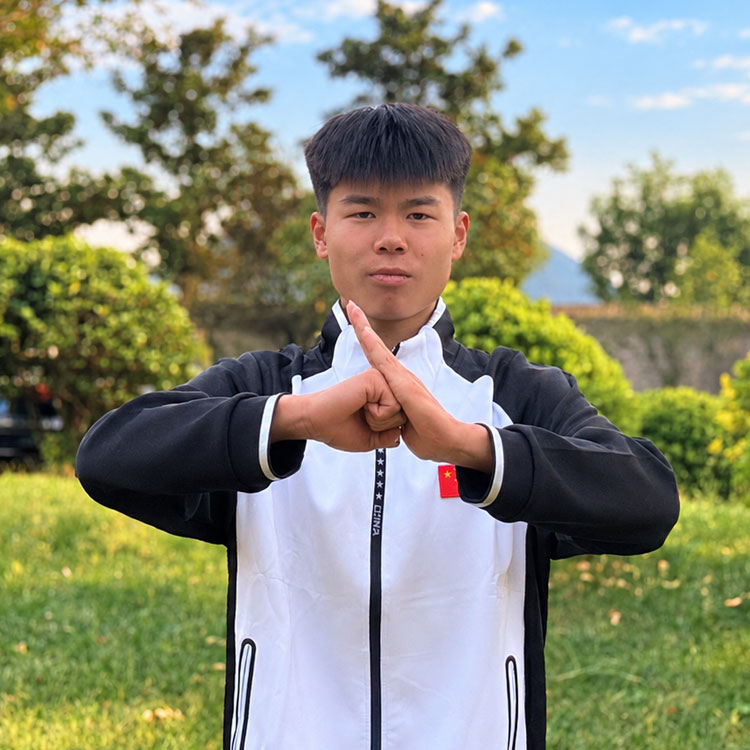


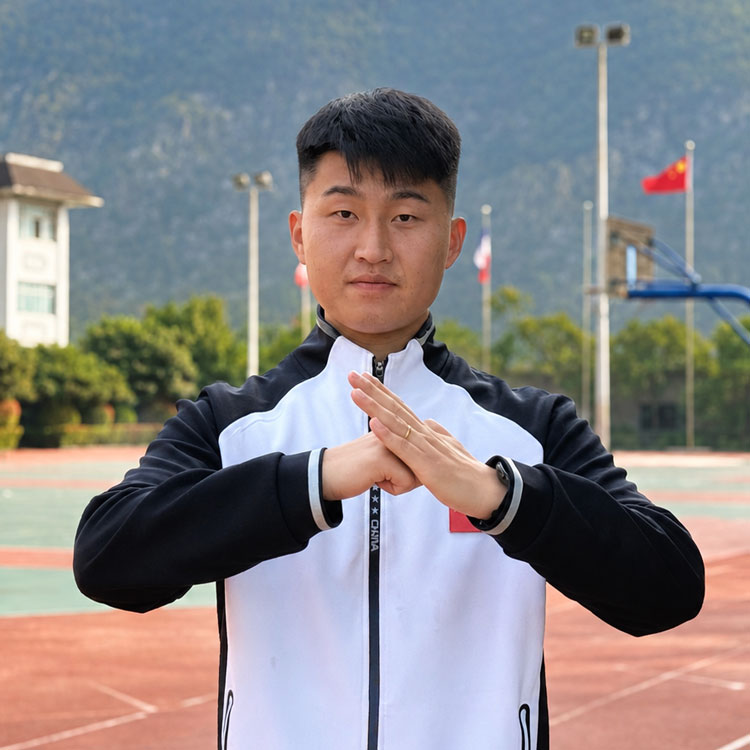

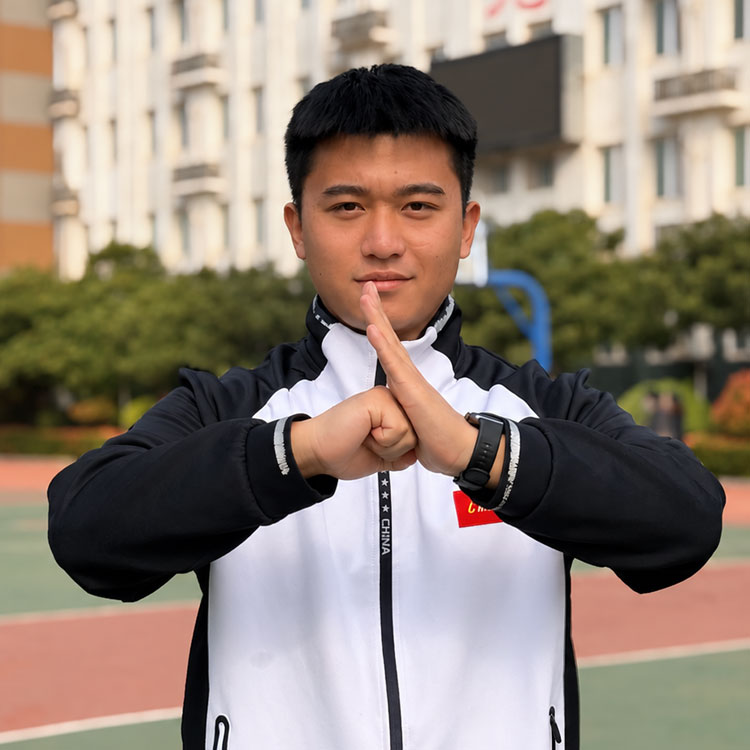
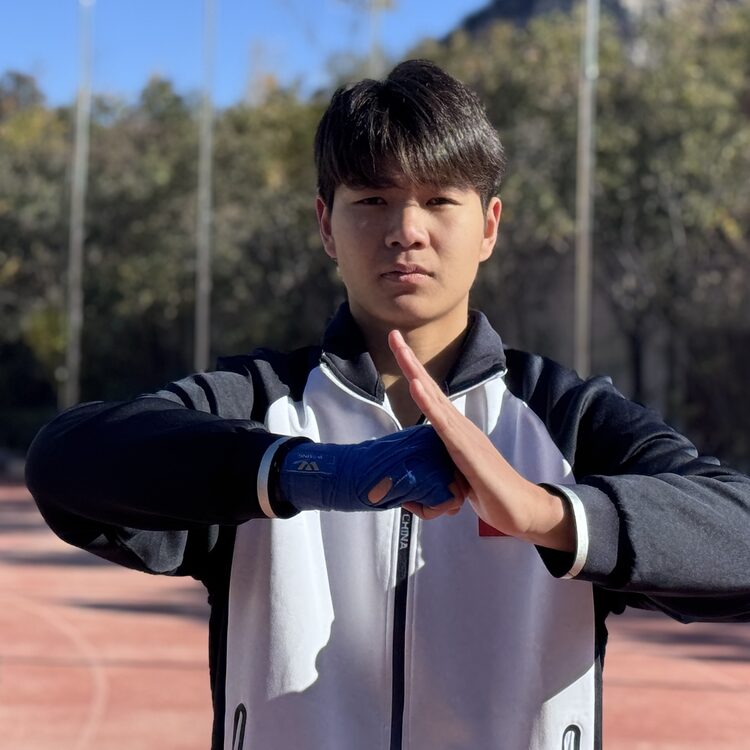

Our Shifus with the fist-and-palm salute. Click a photo to enlarge.
What is the Kung Fu salute called?
Bàoquán lǐ: the salute of the embraced fist.
In Chinese the salute is called 抱拳礼 (bàoquán lǐ). 抱 (bào) means «to embrace» or «to hold», 拳 (quán) means «fist» and 礼 (lǐ) means «ritual», «etiquette» or «respect». So the name literally means «the salute of the embraced fist»: the open hand holds the fist. In English it is usually called the fist-and-palm salute, the Kung Fu salute or the wushu salute.
The salute is used in all Chinese martial arts: in Shaolin Kung Fu, Tai Chi, Sanda, modern competition wushu and many other styles. It is a greeting, a thank-you and a promise at the same time. When you salute, you show your teacher, your partner or your opponent: «I have trained to fight, and I will use this skill with respect and self-control.»
It is closely linked to Wu De, the martial virtue of Chinese martial arts. If Wu De is the moral code, the salute is its sign: a gesture that every student repeats several times a day.
How to do the Kung Fu salute
Step by step, the way it is taught today.
Chinese wushu etiquette describes the salute in detail. These are the steps, as taught in schools and used in competitions:
- 1. Stand upright. Feet together, body straight, head up. Look at the person you are greeting.
- 2. Make a fist with the right hand. A firm, normal fist, not tense.
- 3. Open the left hand. The four fingers are straight and close together. The thumb is bent inwards.
- 4. Cover the fist with the palm. The palm of the left hand lies on the front of the right fist. The base of the left fingers lines up with the knuckles of the fist.
- 5. Hold it in front of your chest. The fingertips of the left hand are about at the height of your chin, the hands 20 to 30 cm in front of the chest.
- 6. Round the arms. The arms form a circle, the elbows point slightly down, the shoulders stay relaxed.
- 7. Pause for a moment. Hold the salute for about one breath, with a calm face and open posture, then lower the hands.
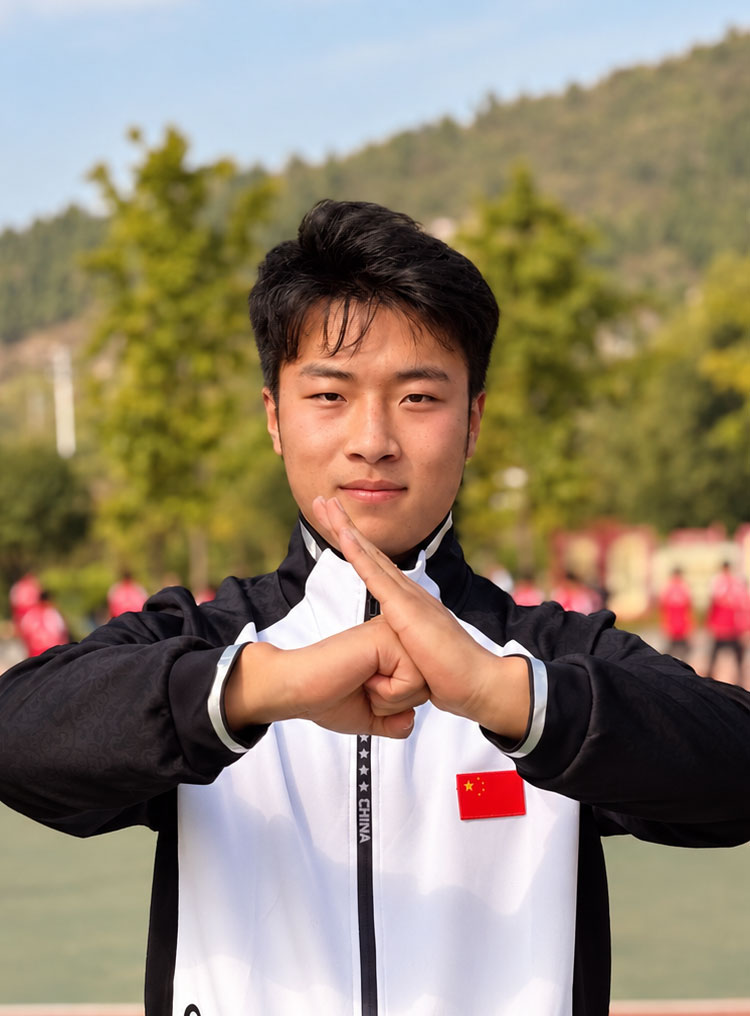


Right fist, open left palm, bent thumb: the salute as our Shifus and students do it every day.
Many schools combine the salute with a slight nod or a small bow. In competition, the salute is short and formal. In daily training it is often a little more relaxed, but it should never be sloppy: a salute made without attention loses its meaning.
The meaning of the fist and the palm
Every detail of the salute tells something.
The meanings below are the ones described in official Chinese wushu etiquette and taught in schools and competitions today. Each part of the gesture stands for a value of the martial artist.
拳 The right fist
The fist stands for martial skill: strength, courage, determination and the will to train hard. It shows that the martial artist is able to defend themselves and others.
掌 The open left palm
The four straight fingers stand for the «four educations» of Chinese school tradition: virtue, wisdom, physical health and art (德智体美). The open hand also means peace, courtesy and good intentions.
拇指 The bent thumb
The thumb of the palm is bent inwards. It reminds the martial artist not to be arrogant and never to put themselves above others. In Chinese, a raised thumb means «the best»; folding it away means «I do not claim to be number one».
掩 The palm covers the fist
Virtue holds strength in check. Two short sayings express it: 勇不滋事, «courage does not stir up trouble», and 武不犯禁, «martial skill does not break the law». You have the power to fight, but you choose not to misuse it.
圆 The round arms
The arms form a circle in front of the chest. This stands for the «five lakes and four seas» (五湖四海): martial artists from everywhere belong to one family and meet each other as friends, 以武会友, «making friends through martial arts».
Another popular reading uses the fingers: the five fingers of the fist stand for the five lakes, the four straight fingers of the palm for the four seas. In both versions the message is the same: martial artists everywhere form one community.
文武 Left and right
The left palm stands for 文 (wén), culture and learning, the right fist for 武 (wǔ), martial skill. Together they express the ideal of 文武兼备: a martial artist should train both mind and body.
Put into one sentence, the salute says: «I have the strength to fight, and the wisdom not to need it.» This is the same idea that stands behind the old Chinese explanation of the character 武 as «stopping the weapons», which you can read about in our article on Wu De.
In Sanda, the Chinese full-contact sport, the salute is not optional: the competition rules require fighters to salute their opponent, the audience and the coaches. At the 15th Chinese National Games in 2025, a Sanda official explained it this way: the right fist and the left palm are the two basic hand shapes of wushu, together they mean the unity of culture and martial skill, and the bent thumb reminds the fighter not to be arrogant.
History of the Kung Fu salute
From ancient Chinese etiquette to the modern competition ring.
The fist-and-palm salute grew out of a much older Chinese way of greeting, in which the hands are joined in front of the chest. These milestones show how it developed:
Kung Fu salute vs. Chinese greeting
Baoquan and gongshou are not the same.
The Kung Fu salute is often confused with 拱手 (gǒngshǒu), the general Chinese greeting with joined hands. They look similar, but they are used differently:
| 抱拳礼 Baoquan (Kung Fu salute) | 拱手 Gongshou (everyday greeting) | |
|---|---|---|
| Hands | Right fist, open left palm, thumb bent | Both hands joined, fingers folded or one hand over the other |
| Used by | Martial artists: training, competition, demonstrations | Everyone: festivals, congratulations, greetings |
| Typical occasion | Greeting the Shifu, before a form, before sparring | Chinese New Year, weddings, birthdays |
| Usual words | Usually silent | «Gongxi» (恭喜, congratulations), «Xinnian kuaile» (新年快乐) |
| Message | Respect, self-control, martial virtue | Politeness, good wishes |
In the traditional gongshou, men usually place the left hand over the right and women the right over the left. The martial salute, by contrast, has one fixed form for everyone: right fist, left palm.
Other salutes in Chinese martial arts
The bow and the salutes with weapons.
Besides the fist-and-palm salute, Chinese wushu etiquette knows other forms of greeting:
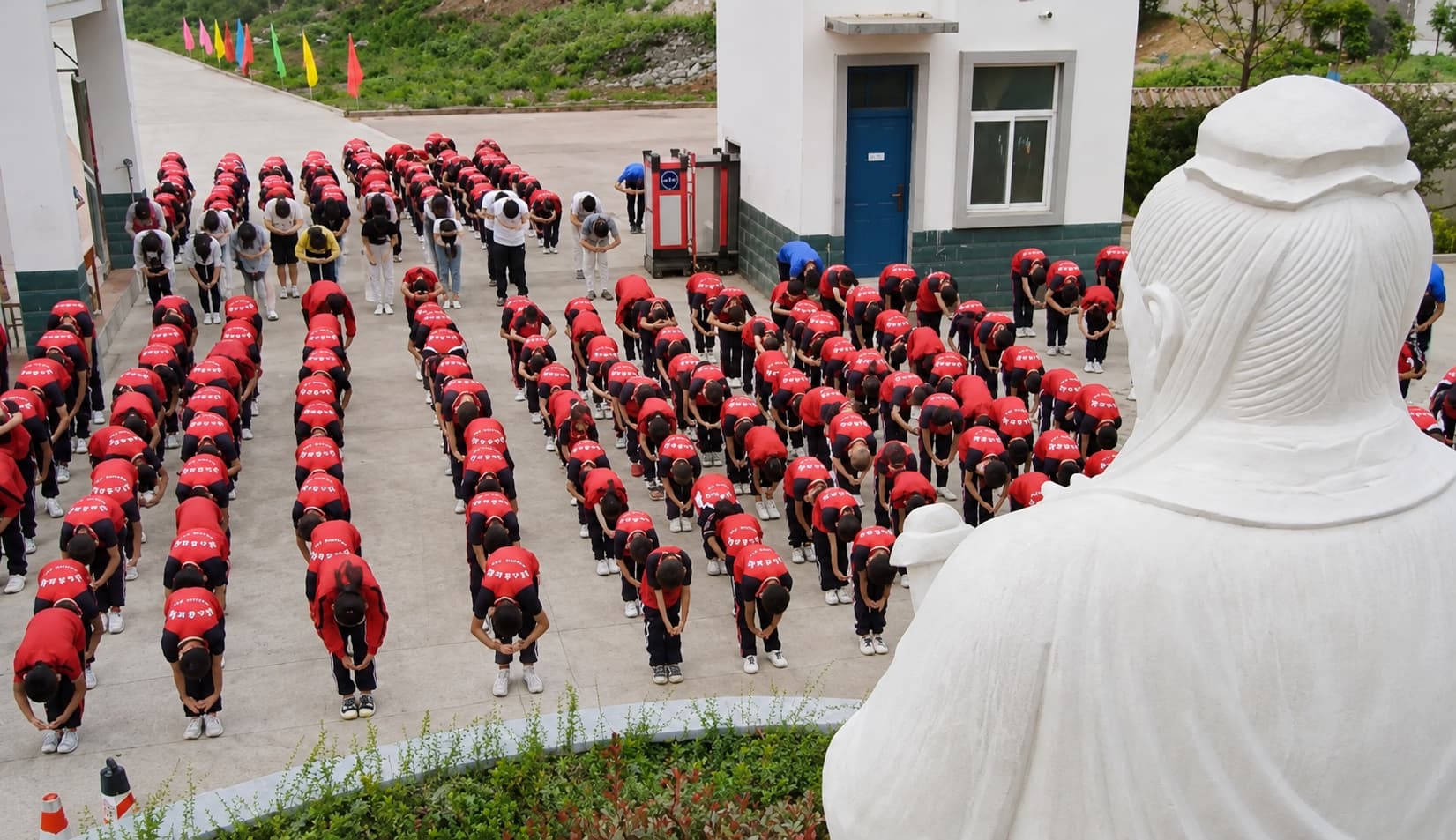
The bow (鞠躬礼)
Standing with feet together, arms at the sides, the upper body leans forward by about 15 degrees. The bow is used to greet teachers and elders, at the end of a performance and on formal occasions where the fist-and-palm salute does not fit. At our school, the Chinese students bow together to the Confucius statue.
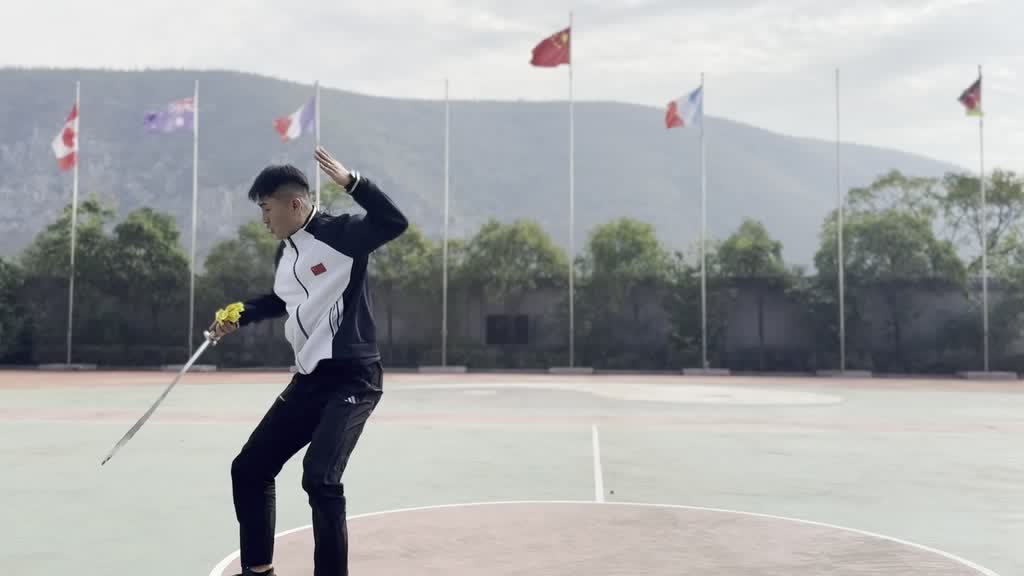
Salutes with weapons
When you hold a weapon, the salute changes. For the broadsword salute (抱刀礼), the left hand holds the sword across the chest and the right hand, as an upright palm with bent thumb, rests against the left wrist. The sword salute (持剑礼) works in a similar way. Every form with a weapon starts and ends with this salute.
Some traditional styles have their own versions of the salute, with slightly different hand positions or extra movements. In Tai Chi, a softer version is common in which the fingers of the palm are relaxed. The basic idea is always the same: strength, held in check by respect.
Common mistakes
What beginners often get wrong.
Almost every new student makes one of these mistakes in the first days. They are easy to correct once you know them:
| Mistake | Why it matters | Correct |
|---|---|---|
| Hands the wrong way round | Left fist and right palm is not the standard form | Right fist, left palm |
| Thumb sticking out | Loses the meaning of modesty | Fold the thumb of the palm inwards |
| Fingers spread apart | Looks careless | Four fingers straight and together |
| Elbows raised high | Tense, aggressive posture | Elbows slightly down, shoulders relaxed |
| Hands too low or too close | Not clearly visible as a salute | Fingertips at chin height, 20 to 30 cm from the chest |
| Looking away, rushing | The salute becomes empty | Look at the person, hold for one breath |
The salute at our school
Several times a day, in every class.
At our school in the Yuntai Mountains, the salute is part of every training day. You will use it from the very first lesson:
- At the start and end of every class. The whole group salutes the Shifu, and the Shifu salutes back.
- Before and after a form. Whether in Shaolin Kung Fu or Tai Chi, every form begins and ends with the salute.
- With a partner. Before a partner drill or a round of Sanda sparring, and as a thank-you afterwards.
- At competitions and performances. Our students salute the judges and the audience before and after their routine.
- At Chinese New Year. During the festive days, people wish each other a happy new year with joined hands, and martial artists often use the fist-and-palm salute.
The salute also teaches something beyond the training hall. When you greet a person with full attention, even for just one second, you show respect, and respect is the foundation of everything else in Kung Fu.
Planning your stay?
Get our packing list and planning tips
The packing list as a PDF to tick off, plus tips on budget, visa and travel by email.
5 tips to practise the salute
Small details that make a big difference.
1. Practise in front of a mirror
Check the position of the hands: right fist, left palm, thumb bent, fingers together, fingertips at chin height. Correct one detail at a time until the shape feels natural.
2. Relax the shoulders
Many beginners pull up their shoulders and elbows. Breathe out, let the shoulders sink and keep the arms round. The salute should look calm, not tense.
3. Make eye contact
The salute is a greeting between people. Look at the person you salute, briefly and kindly. In a group, look at the Shifu.
4. Hold for one breath
Do not rush. Hold the salute for one calm breath before lowering the hands. This small pause turns a habit into a moment of attention.
5. Think of what it means
Once in a while, think about the meaning while you salute: strength under control, modesty, respect for the other person. This is how the gesture becomes a daily practice of martial virtue.
Ready to start your training?
No deposit and no application fee. You only pay after you arrive at the school.
- Start any week
- Invitation letter for your visa
- Free pickup in Zhengzhou
FAQ: the Kung Fu salute
In Chinese it is called 抱拳礼 (bàoquán lǐ), «the salute of the embraced fist». In English it is known as the fist-and-palm salute, Kung Fu salute or wushu salute.
The right fist stands for martial skill and courage, the open left palm for virtue, learning and peace. The palm covering the fist means that strength is held in check by morality. The bent thumb stands for modesty, and the round arms for the unity of all martial artists.
The right hand makes the fist and the open left hand covers it. This is the standard form in Chinese martial arts and in modern wushu competitions.
The bent thumb is a sign of modesty. In China, a raised thumb means «the best». Folding it inwards shows that the martial artist does not consider themselves superior to others.
Baoquan (抱拳礼) is the martial arts salute with a right fist and open left palm. Gongshou (拱手) is the general Chinese greeting with joined hands, used by everyone, for example at Chinese New Year or to congratulate someone.
It developed from the traditional Chinese hand greeting, which has existed for about three thousand years. The martial arts version with fist and palm was standardised in modern wushu, with fixed meanings for each part of the gesture.
The story that the palm and fist represent the sun and moon, which together form the character 明 (Ming), is a popular legend connected with secret societies of the Qing dynasty. It is not proven history.
At the start and end of every lesson, to greet the teacher, before and after a form, before and after sparring, at competitions and performances, and as a festive greeting, for example at Chinese New Year.
Often the salute is combined with a slight nod. A real bow (鞠躬礼) is a separate form of greeting, used for example to greet teachers or at the end of a performance.
The basic form is the same. Some styles, especially Tai Chi, often use a softer version with relaxed fingers. Some traditional styles have their own variations, but the meaning of strength under control stays the same.