

BEFORE YOU LEAVE
You wanna be the first to hear about all news of our school and get special offers?



Hard training needs good food. At Shaolin Yuntai, three warm meals a day are included in your price, seven days a week, with vegetarian and vegan options. Here you find out what is on the table, how we cater for special diets, where you can cook for yourself, and what Shaolin monks traditionally eat.
3 meals a day included7 days a weekVegetarian and veganCommunal kitchen
Chinese home cooking in our dining hall.
All students eat together in our dining hall, international and Chinese students at the same times. Your full board includes three warm meals a day, seven days a week, also on Sundays and holidays. The food is simple Chinese home cooking: filling, fresh and made for people who train hard. You eat with chopsticks, and the most important table manners are in our guide to Chinese etiquette.

Bright, spacious and new. Here you meet everyone three times a day, the best place to make friends.

After training, students sit together, talk about the day and recharge for the next session.
We always want to offer our students the right food for daily training. Have an idea for a dish you would like to eat? Just let us know, or show us how to cook it, and we do our best to make it.
Yes, vegetarians and vegans are very welcome.
We are often asked whether we offer vegetarian or vegan meals. Of course we do. Vegetarians and vegans are very welcome, and we take care of you just as well as of any other student. Chinese cooking has a long tradition of vegetarian dishes with tofu, vegetables, rice and noodles, so you will not go hungry.
Every day there are both meat and vegetable dishes, and you can choose vegetarian or vegan ones. Just tell us when you apply.
Do you have other dietary needs or allergies? Let us know before you arrive, and we do our best to put together a menu that suits you.
Good to know: Chinese cooking often uses garlic, chili, soy sauce and peanut oil. If you have an allergy, tell us clearly in advance, and bring a note in Chinese that you can show in restaurants outside the school.
Cook your favourite dish or meet for tea.
To meet the needs of our international students, we added a large communal kitchen. Here you can cook your favourite meals and try dishes from all over the world. The kitchen has become a lively meeting place where cultures come together.

Open to all students. Cook something from home and share it with your fellow students.
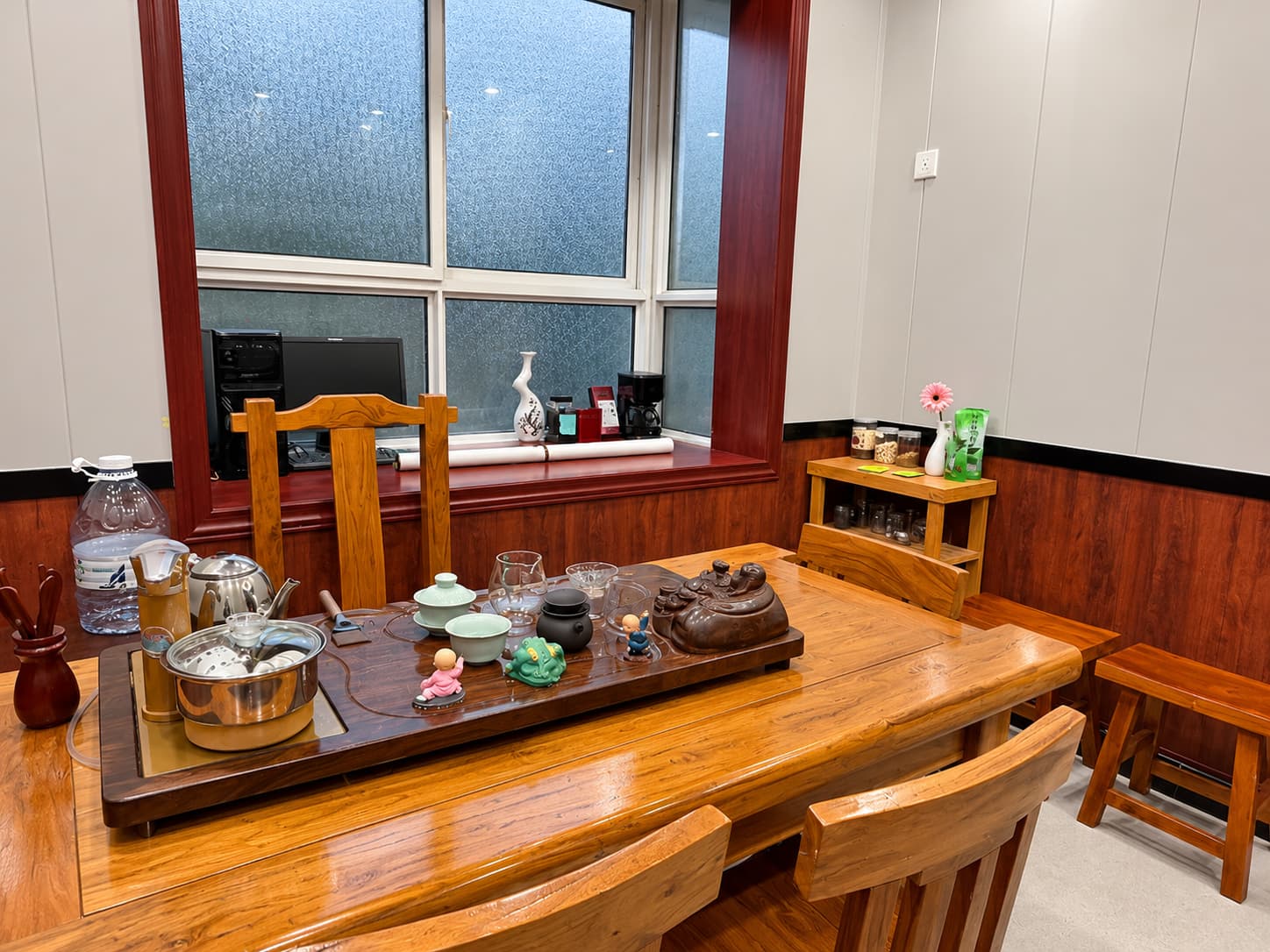
A quiet room with a traditional tea table. Learn more about the Chinese tea ceremony.
School shop: On the campus, you can buy fruit, snacks, drinks, everyday items and training equipment whenever you need them. For more choice, there are also shops in the next town.
Simple habits that help you train well.
With three to four training sessions a day, your body needs energy and time to recover. These simple habits help, especially in your first weeks.

More tips for your first weeks in our guide on how to prepare for Kung Fu training in China.
The Buddhist diet of the Shaolin Temple.
The monks of the Shaolin Temple are Chan Buddhists, and like most Buddhist monks in China, they eat a vegetarian diet. Chinese Buddhism has followed this rule for about 1,500 years: in the early 6th century, Emperor Wu of Liang, a devout Buddhist, called on monks and nuns to give up meat and alcohol. Not killing living beings is one of the Buddhist precepts, see Buddha and Buddhism.
Monastery food is simple: rice, noodles, steamed buns, tofu, vegetables, beans and tea. Many Chinese Buddhist monks also avoid the so-called five pungent vegetables (五荤, wǔ hūn), such as garlic and onions. The reason is not the protection of animals: according to tradition, these strong flavours stir up the mind and disturb inner calm.
The character 素 (sù) means plain or simple, and also vegetarian. Vegetarian food in China is called 素食 (sùshí), and many Buddhist temples run their own vegetarian restaurants.
| Shaolin monks | Our school | |
|---|---|---|
| Meat and fish | No, strictly vegetarian | Sometimes, with vegetarian and vegan options |
| Garlic and onions | Traditionally avoided | Part of normal Chinese cooking |
| Typical food | Rice, noodles, buns, tofu, vegetables | Rice, buns, porridge and many vegetables |
| Meals | Simple, often eaten in silence | Three warm meals a day, eaten together |
Our school is not a monastery: you don’t have to become vegetarian to train Shaolin Kung Fu. If you would like to try a vegetarian diet during your stay, just tell us.


Mealtimes at the school: from our photo archive.
Ready to start your training?
No deposit and no application fee. You only pay after you arrive at the school.
Food and meals at our Kung Fu school: your questions.
Yes. Three warm meals a day, seven days a week, are included in your all-inclusive price. You only pay extra for snacks and drinks from the shop or for eating out.
Simple Chinese home cooking. Breakfast is, for example, steamed buns and Chinese porridge. Lunch and dinner are rice with a wide variety of vegetables, sometimes with fish or meat.
Breakfast at 07:10, lunch at 11:30 and dinner at 17:30, between the training sessions.
Yes. Vegetarians and vegans are very welcome, and we prepare vegetarian or vegan meals for you. Just tell us when you apply.
Yes. Let us know about your dietary needs or allergies before you arrive, and we do our best to put together a menu that suits you. You can also cook for yourself in the communal kitchen.
Yes. Our large communal kitchen is open to all students, for example to cook a dish from home and share it with others.
Yes. The school shop on the campus sells fruit, snacks, drinks, everyday items and training equipment. There are more shops in the next town.
The tap water in the renovated rooms is drinkable, so a reusable bottle is all you need.
Shaolin monks are Chan Buddhists and eat a vegetarian diet: rice, noodles, steamed buns, tofu, vegetables, beans and tea. Many Chinese Buddhist monks also avoid garlic, onions and other pungent vegetables, as well as alcohol.
No. Our school is not a monastery. We serve normal Chinese food with vegetarian and vegan options. If you want to eat vegetarian during your stay, just tell us.