

BEFORE YOU LEAVE
You wanna be the first to hear about all news of our school and get special offers?

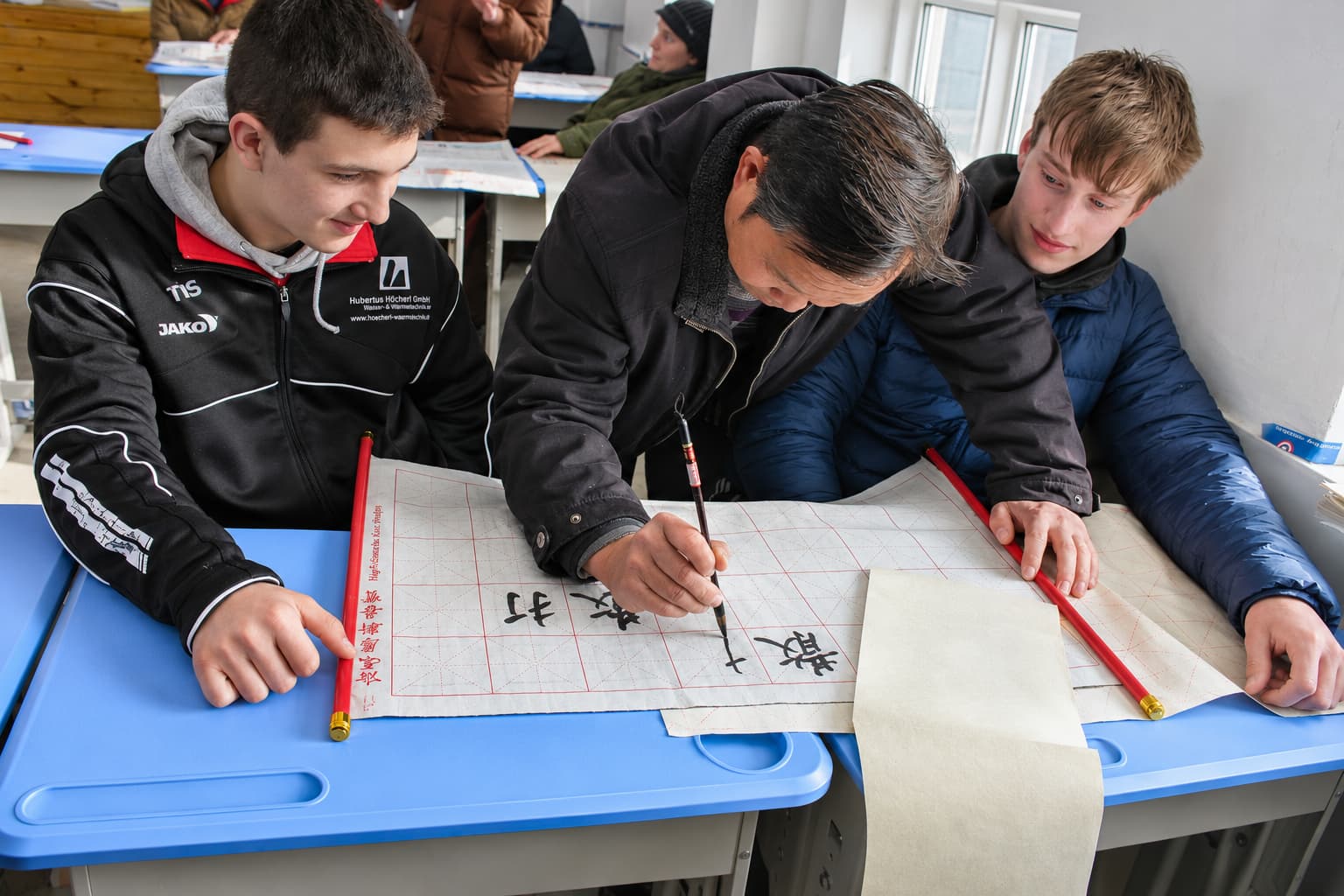
Chinese calligraphy is more than beautiful writing. It trains concentration, breath and patience, just like Kung Fu, Tai Chi and Qi Gong. At Shaolin Yuntai, you can take part in our calligraphy classes during your stay: no prior knowledge or artistic talent needed. Here you find out what to expect in class and learn the basics of this 2,000-year-old art.
No experience neededIncluded in your priceVoluntaryCombine with Kung Fu
Create your own Chinese calligraphy.
Our calligraphy classes are part of the Chinese culture classes at the school. They usually take place every two weeks, last about one hour and run all year round. They are included in your price and voluntary, so you can join whenever you like. You learn how to hold the brush, how to sit and breathe, and how to write the basic strokes and your first characters. No prior knowledge or artistic skills are required.


Calligraphy classes at the school: from our photo archive.
Combine calligraphy with our Mandarin lessons: writing characters with the brush helps you remember them much better.
Calm mind, steady breath, full focus.
Calligraphy and the martial arts have a lot in common. In both, you practise basic movements thousands of times until they become natural. In both, posture, breath and intention come before strength. When you write, you calm your mind, slow down your breath and put your full attention into a single stroke, much like in meditation, Qi Gong or Tai Chi. The brush moves from the whole arm and body, not only from the fingers.

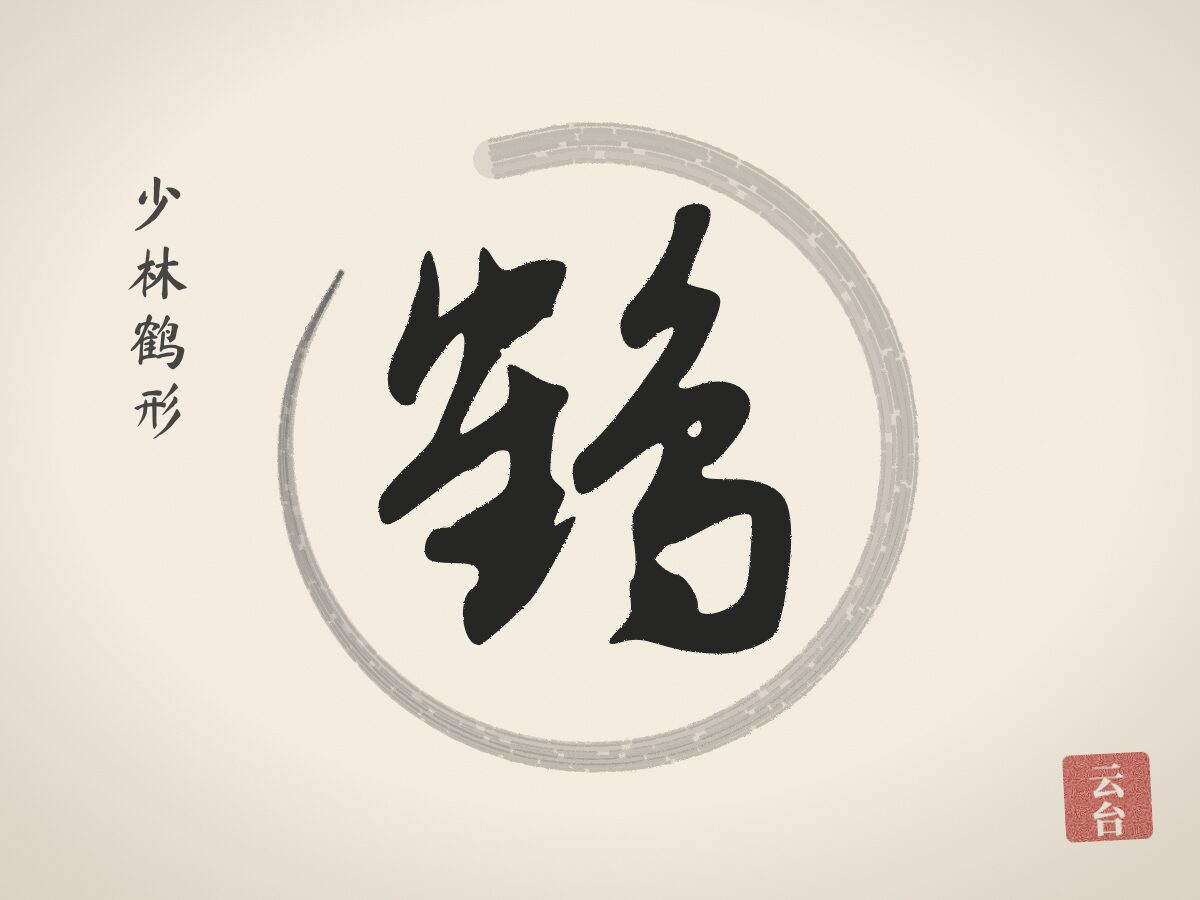

Tiger, crane and dragon: three Shaolin animal styles written with the brush. More on the Shaolin Kung Fu page.
文房四宝 · wénfáng sìbǎo
Chinese scholars called the four basic tools of calligraphy the «four treasures of the study». In class, all four are ready for you, so you don’t need to bring anything.
Made of animal hair in a bamboo handle. Soft and flexible, so every change of pressure shows in the line.
Traditionally an ink stick of soot and glue, ground with water. Today many beginners use bottled ink.
Thin, absorbent rice paper (Xuan paper). It shows every hesitation, so you learn to write with confidence.
The stone on which the ink stick is ground. Grinding the ink slowly was also a way to calm the mind before writing.
From ancient seals to free-flowing cursive.
Over more than 2,000 years, Chinese writing developed into five main script styles. Beginners usually start with regular script, because every stroke is clear and separate.
| Script | Character and use |
|---|---|
| Seal script (篆书) | The oldest of the five, with even, rounded lines. Still used today for name seals. |
| Clerical script (隶书) | Flat, wide characters with wave-like strokes, used by officials in the Han dynasty. |
| Regular script (楷书) | Clear and balanced. The standard script of printed Chinese and the starting point for learners. |
| Running script (行书) | Faster and more connected, the everyday handwriting of calligraphers. |
| Cursive script (草书) | Free, fast and expressive. Often hard to read, but highly valued as art. |
The most famous Chinese calligrapher is Wang Xizhi (4th century), known as the «Sage of Calligraphy». In 2009, UNESCO added Chinese calligraphy to its list of the Intangible Cultural Heritage of Humanity.
Everything starts with one character.
For centuries, calligraphy students have practised with the character 永 (yǒng, «eternal»). It contains the eight basic strokes of Chinese writing, such as the dot, the horizontal and vertical line, the hook and the sweeping strokes to the left and right. Master these eight, and you can write almost any character. This method is called the «eight principles of yong» (永字八法).
In calligraphy, you never go back over a stroke to correct it. Every line is written once, in one breath. Like a Kung Fu technique, it is either right or you practise it again.
Ready to start your training?
No deposit and no application fee. You only pay after you arrive at the school.
Learning Chinese calligraphy: your questions.
No. Our calligraphy classes are made for beginners. You don’t need to speak Chinese or have any artistic talent.
Yes. Calligraphy is part of the Chinese culture classes, which are included in your all-inclusive price. The classes usually take place every two weeks for about one hour. Taking part is voluntary.
Yes. Calligraphy is a culture class next to your normal training in Shaolin Kung Fu, Wushu, Tai Chi, Qi Gong or Sanda.
The four treasures of the study: a brush, ink, rice paper and an inkstone. For the classes, you don’t need to bring anything.
Regular script (楷书), because every stroke is clear and separate. Once you master it, you can move on to running script.
The character 永 (yǒng, «eternal») contains the eight basic strokes of Chinese writing. Calligraphy students have practised with it for centuries.
Yes. Writing characters by hand, stroke by stroke, helps you remember them. It goes perfectly with our Mandarin lessons.
Because you need a calm mind, steady breath and full attention for every stroke. Many students find it relaxing after a hard training day.