




 Shaolin Kung Fu ›
 Tai Chi ›
 Lion & Dragon Dance ›
BEFORE YOU LEAVE
You wanna be the first to hear about all news of our school and get special offers?
Yes, I Want This »


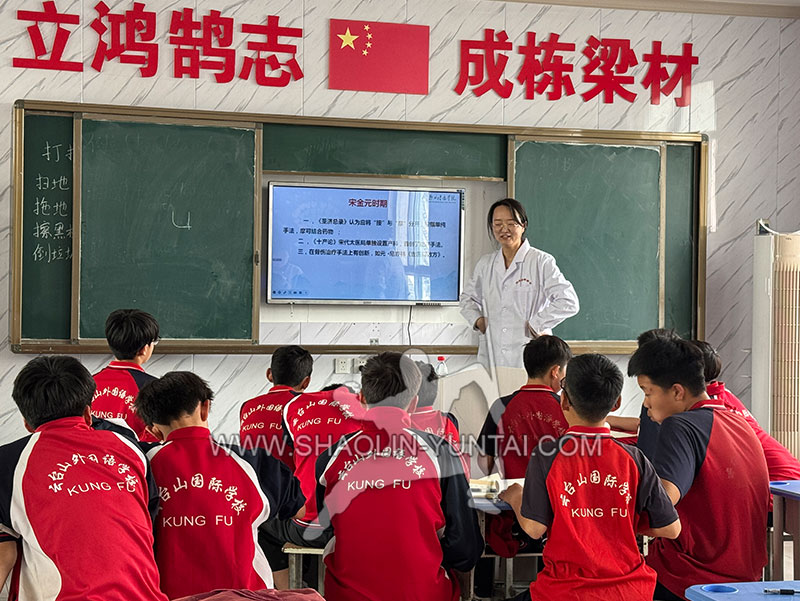
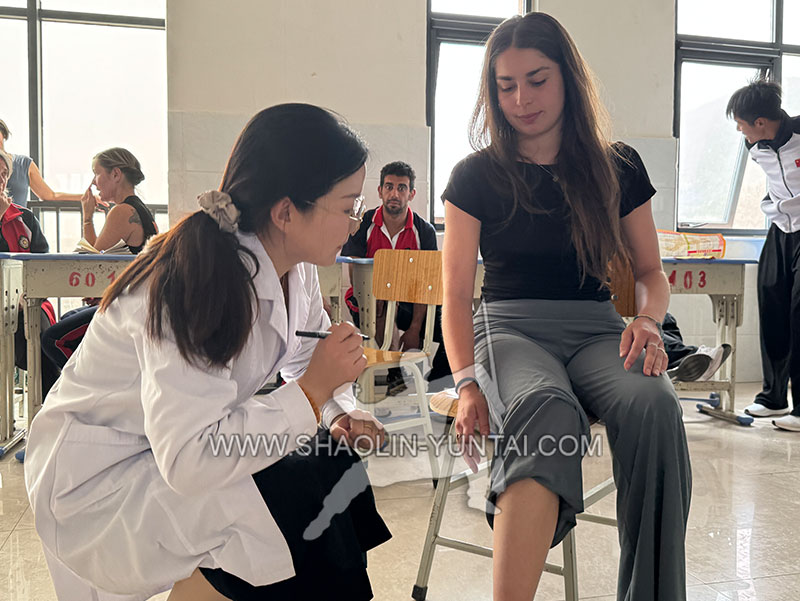
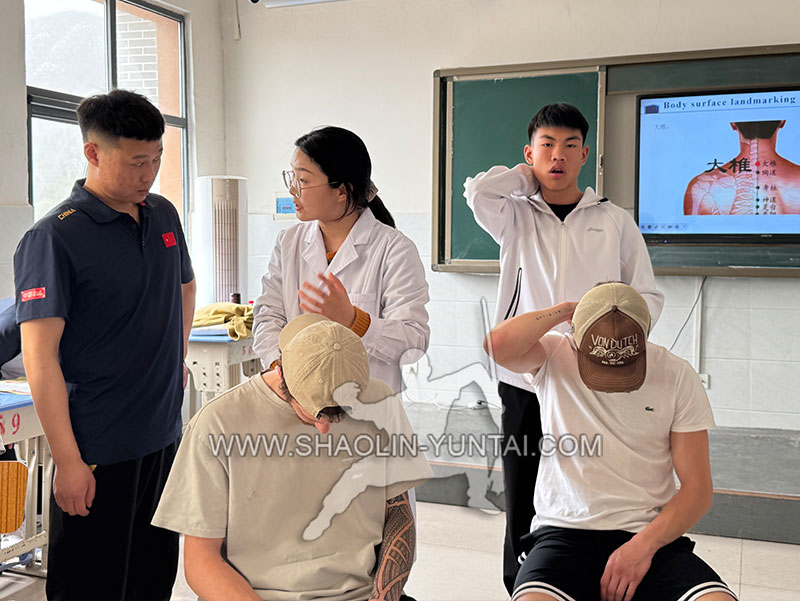
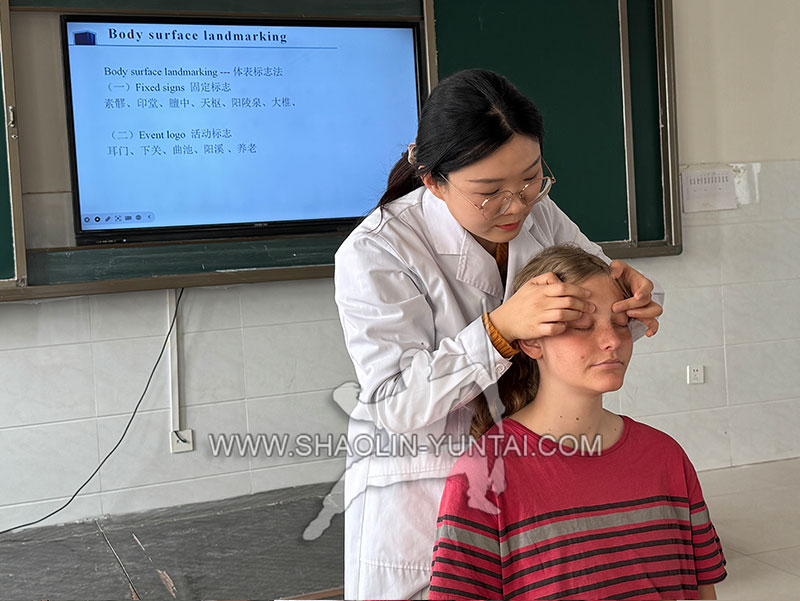
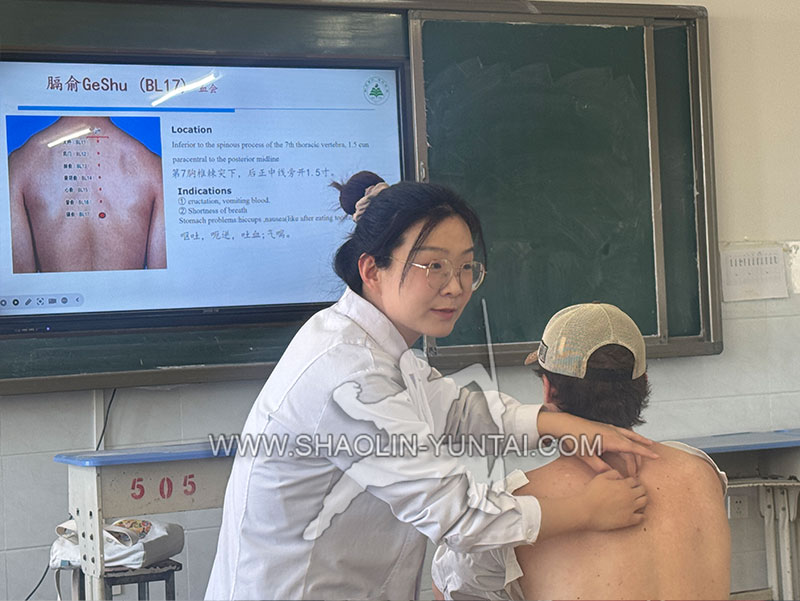
Learn Tui Na (also written Tuina), the traditional Chinese massage, and other methods of Traditional Chinese Medicine (TCM) at our Kung Fu school in the Yuntai Mountains of Henan. Once a week, our TCM teachers, who also work in local hospitals, show you Tui Na massage, cupping, gua sha, moxibustion and acupuncture. The class is optional and included in your stay.
Included in your stayOnce a weekNo experience neededTeachers from local hospitals
Impressions from our TCM class. Click a photo to enlarge.
Chinese therapeutic massage.
Tui Na, also written Tuina, is one of the main treatment methods of Traditional Chinese Medicine, next to acupuncture and herbal medicine. Unlike a relaxing wellness massage, it works with acupressure points and the meridians, the channels through which Qi, the life energy, flows according to TCM. Techniques like pushing, rolling, kneading and pressing are used for muscle tension, back and neck pain and sports injuries.
In Chinese hospitals and clinics, Tui Na is used for tense muscles, back, neck and shoulder pain, stiff joints and sports injuries, and also for general well-being and relaxation. In China, there is even a special form of Tui Na for children.
Follows the ideas of Chinese medicine. Works along the meridians and on acupressure points, with many hand techniques like pushing, grasping, rolling and stretching. Often treats areas away from where it hurts.
A Western massage with slow, firm pressure on the deep layers of the muscles. It focuses directly on the tense or painful area.
Tui Na has many hand techniques. These six are among the most important ones, and you practise several of them in class:
Tui Na means “push and grasp”, two of the basic hand techniques you learn in class.
Chinese medicine, simply explained.
Traditional Chinese Medicine is a system of healing that has developed in China over more than 2,000 years. It looks at the body as a whole: health means balance, and complaints are seen as a sign that this balance is disturbed. In China, TCM is not alternative medicine. It is part of the public health system, with its own universities and hospitals, and it is often used together with Western medicine.
According to TCM, Qi, the life energy, flows through the body in channels called meridians. Along them lie the acupuncture points. When Qi flows freely, you are healthy. When it is blocked, pain and complaints appear.
Every person, organ and illness has a Yin side (calm, cool, inner) and a Yang side (active, warm, outer). TCM tries to bring the two back into balance. The same idea is behind Tai Chi and Yin and Yang in Shaolin Kung Fu.
TCM rests on several pillars: acupuncture and moxibustion, herbal medicine, Tui Na massage, nutrition and movement practices like Qi Gong and Tai Chi. In our TCM class, you get to know the hands-on methods.
“Where there is flow, there is no pain. Where there is pain, there is no flow.”Classic saying of Chinese medicine (通则不痛,痛则不通)
Five classic methods of Chinese medicine.
Your teacher explains and demonstrates each method, and you try the hands-on techniques yourself under guidance. Tui Na is at the centre, and the other methods show you how Chinese medicine works as a whole.
 推拿
Chinese therapeutic massage. Pushing, grasping, kneading and pressing along the meridians and acupressure points.
拔罐Cups create suction on the skin. In TCM, cupping is used for tense muscles and to stimulate circulation.
刮痧A smooth tool is scraped over oiled skin. In TCM, it is used for tension and to stimulate circulation.
艾灸Dried mugwort (moxa) is burned close to acupuncture points to warm them.
针灸The best-known TCM method: fine needles are placed at specific points along the meridians.

Once a week. Optional. Included.
When the class takes place. The TCM class runs all year, except in July, August and during Chinese New Year. In these months, our TCM teachers are fully busy at the hospitals. If TCM is important to you, plan your stay outside these months.
See where the TCM class fits into your week: training schedule.
More than 2,000 years of hands-on healing.
Massage is one of the oldest healing methods in China. For centuries, Tui Na was passed on from teacher to student. Today, it is taught at TCM universities and used in hospitals, and our TCM teachers bring this everyday hospital practice into the classroom.
Learn it where it is part of everyday life.
Healing has always been part of martial arts.
Kung Fu training is hard on the body. Traditionally, martial arts teachers also knew how to treat bruises, strains and sore muscles. In China, this knowledge is called Die Da (跌打), which means “fall and hit”. Learning Tui Na helps you understand your own body, recover better after training and help your training partners.
Tui Na, Qi Gong and Tai Chi share the same ideas of Qi and the meridians. If you train one of them, the others become easier to understand.
Curious minds, no experience needed.
Simple Tui Na, acupressure and gua sha techniques you can use for yourself, your family and your training partners, for example after a hard training day. You know what cupping, moxibustion and acupuncture are and how they are used. And you understand your body better from the point of view of Chinese medicine.
The TCM class is an introduction and hands-on practice during your stay. It is not a professional therapist training.
Ready to start your training?
No deposit and no application fee. You only pay after you arrive at the school.
Learning Tui Na in China: your questions.
Tui Na is Chinese therapeutic massage and one of the main treatment methods of Traditional Chinese Medicine. It works with acupressure points and the meridians, using techniques like pushing, grasping, kneading and pressing.
TCM stands for Traditional Chinese Medicine, a system of healing that has developed in China over more than 2,000 years. It includes acupuncture, herbal medicine, Tui Na massage, nutrition and movement practices like Qi Gong. In China, it is part of the public health system.
Yes. The TCM class is included in your all-inclusive price, together with your training, room, three meals a day and free pickup. There is no extra fee. See all prices.
Once a week, usually on Wednesday afternoon. The class is optional, so you decide if you join.
The TCM class runs all year, except in July, August and during Chinese New Year. In these months, our TCM teachers are fully busy at the hospitals.
Tui Na massage, cupping, gua sha, moxibustion and acupuncture. Your teacher explains and demonstrates each method, and you try the hands-on techniques yourself under guidance.
Our TCM teachers also work in local hospitals, so you learn from people who use Chinese medicine every day.
No. The class is open to all students, no matter if you have done massage or bodywork before.
Yes. Simple Tui Na, acupressure and gua sha techniques are easy to use for yourself, your family and your training partners, for example after a hard training day. Methods like acupuncture belong in the hands of trained therapists, but you will know what they are and how they work.
No. The TCM class is an introduction and hands-on practice during your stay at our Kung Fu school. It does not qualify you to work as a therapist. For that, you need a professional training at a TCM university or school.
Yes. The TCM class fits around your training. You train Shaolin Kung Fu, Tai Chi or Qi Gong as usual and join the TCM class once a week.
A wellness massage mainly relaxes the muscles. Tui Na is a treatment method of Chinese medicine: it works with acupressure points and the meridians and is used for specific complaints like muscle tension or back pain.
Mix styles during your stay.