

BEFORE YOU LEAVE
You wanna be the first to hear about all news of our school and get special offers?
Yes, I Want This »

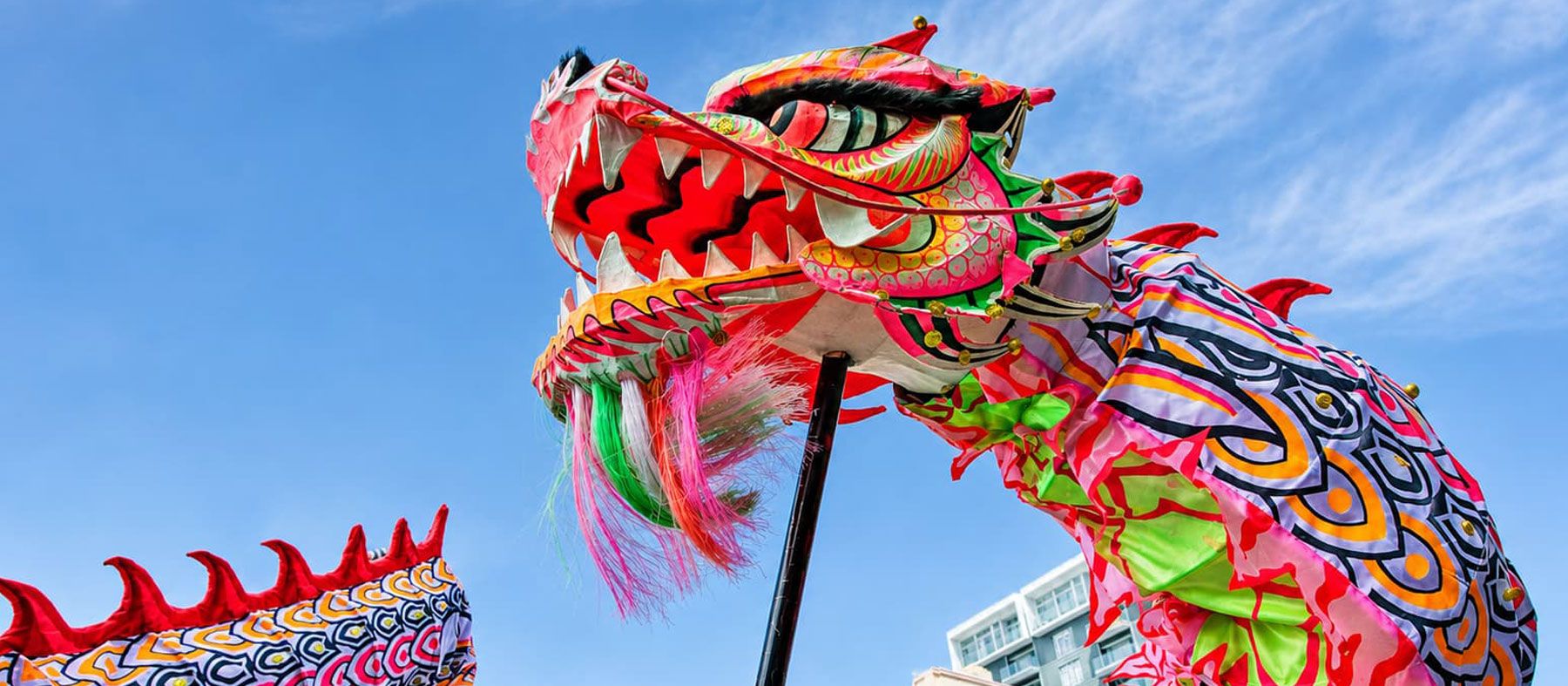
The lion and dragon dance are two of China’s most famous traditions: loud drums, bright colours and dancers who bring a lion or a dragon to life. Here you find out where the dances come from, what they mean, how a lion dance differs from a dragon dance, and how you can learn both at our Kung Fu school in China, at no extra cost.
Included in your priceLion and dragon dancePlum blossom poles on campusShows possible
At no extra cost, next to your Kung Fu training.
At Shaolin Yuntai, the lion and dragon dance is an interest class that you can add to your normal training. It costs nothing extra. Our Chinese students practise it regularly, so as an international student you can join at any time, either together with the Chinese students or as your own group. A session lasts about one and a half hours, and the classes are arranged according to the students’ wishes.
We mainly teach the Southern lion (南狮), the style with the big expressive head, and we also teach the dragon dance. On our campus, we have plum blossom poles (梅花桩) for lion dance training. Your teacher is Shifu Zhang Qi. Students also have the chance to take part in shows and performances.

A team sport: many dancers, one dragon. You learn to move in perfect harmony with the others.

Two dancers, one lion: strength, balance and expression, from the ground up to the poles.
How long does it take? The lion and dragon dance is difficult. To really learn it, plan at least three months. If you stay for a shorter time, you can still join the training and get to know the basics.
Two traditions that are often confused.
Both dances belong to Chinese festivals and are often performed together, but they are very different. The most important rule of thumb: a lion is danced by two people, a dragon by a whole team.
| Lion dance (舞狮) | Dragon dance (舞龙) | |
|---|---|---|
| Dancers | Two per lion: one for the head, one for the tail | A team that carries the dragon on poles, often nine or more |
| Movement | Lifelike: the lion sleeps, wakes up, plays, is curious and jumps | Flowing waves and spirals, the dragon chases a pearl |
| Meaning | Courage, protection, driving away bad luck | Power, wisdom, rain, a good harvest and prosperity |
| Typical occasions | Chinese New Year, shop openings, weddings, festivals | Chinese New Year, Lantern Festival, large parades |
| Skills | Strength, balance, acrobatics and expression | Teamwork, timing and endurance |
Two thousand years of tradition.
The dragon dance is usually traced back to the Han dynasty (206 BC to 220 AD). In Chinese belief, dragons ruled over water and rain, so people danced with dragon figures to ask for rain and a good harvest. Over the centuries, the ritual became a festival tradition.
The lion dance has a surprising origin: there have never been wild lions in China. Lions came to the imperial court as gifts along the Silk Road, and with them stories and images of the lion as a noble, protective animal. By the Tang dynasty (618 to 907), lion dances were performed at court. Later, two main styles developed: the Northern lion and the Southern lion, which took its typical form in Guangdong province in southern China.


Dragon with the pearl, lions in three colours and a dragon head up close.
A popular legend tells of Nian, a monster that came out every New Year’s Eve to attack villages. People found out that Nian was afraid of the colour red, loud noise and bright light. Since then, red decorations, firecrackers and the noisy lion dance with drums and cymbals have been part of Chinese New Year, to drive away bad luck for the year ahead. The Chinese word for celebrating the New Year, 过年 (guò nián), is often explained as «getting past Nian».
Power, luck and perfect teamwork.
In China, the dragon is not a dangerous monster but a wise and powerful being that brings rain, luck and prosperity. For centuries, it was also the symbol of the emperor. In the dragon dance, a team of dancers holds the long body of the dragon on poles. In front of them, a lead dancer carries a ball, the pearl, which the dragon chases. The longer the dragon, the more dancers it needs.
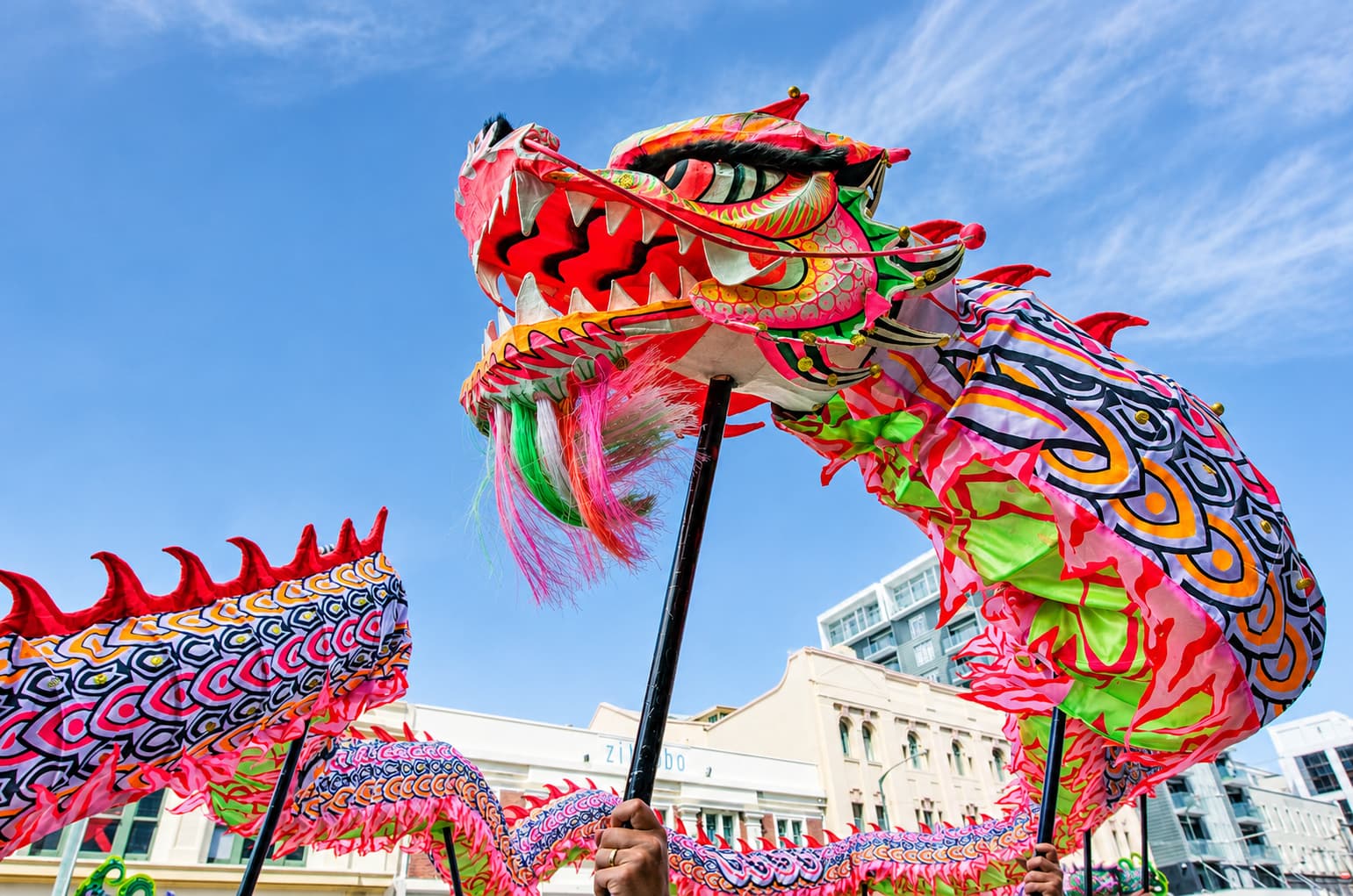
Waves, spirals, circles and figure eights. The dragon rises, dives and coils around itself, and every dancer must be in the right place at the right moment.

If one dancer is too early or too late, the whole dragon loses its flow. That is why the dragon dance trains timing, endurance and team spirit.
Colours have a meaning too: green often stands for a good harvest, red for joy and luck, and gold or yellow for the emperor and wealth.
Each dancer holds one pole under one section of the dragon’s body. A dragon for performances usually has nine sections or more, because odd numbers are considered lucky in Chinese tradition. Long dragons for parades can need dozens of dancers, who take turns because the dance is so tiring. The most important roles are:
The pearl stands for wisdom, the moon and good fortune. The dragon follows it but never quite catches it: a picture of the constant search for wisdom and luck. Whoever carries the pearl leads the whole dance.
Besides the classic dragon, there are many regional forms. At night, dragons with lights inside glow in the dark. Some villages dance with dragons made of straw or benches. One of the most famous is the fire dragon dance in Tai Hang in Hong Kong, where a dragon covered with burning incense sticks winds through the streets at the Mid-Autumn Festival.
Northern lion and Southern lion.
The lion is a symbol of courage and protection. In the lion dance, two dancers become one animal: the dancer at the front moves the head and controls the eyes, mouth and expressions, while the dancer at the back forms the body and tail and lifts the head dancer in jumps. Together, they show the lion’s character: curious, playful, proud and sometimes cheeky.
| Northern lion (北狮) | Southern lion (南狮) | |
|---|---|---|
| Look | Shaggy, closer to a real lion, often in pairs | Large, colourful head with a horn, movable eyes and mouth |
| Style | Playful and acrobatic, like a circus act | Expressive, powerful, close to Kung Fu stances |
| Highlight | Balancing on balls and acrobatics | Jumps on high plum blossom poles |
| At our school | Not the main focus | Our main style |
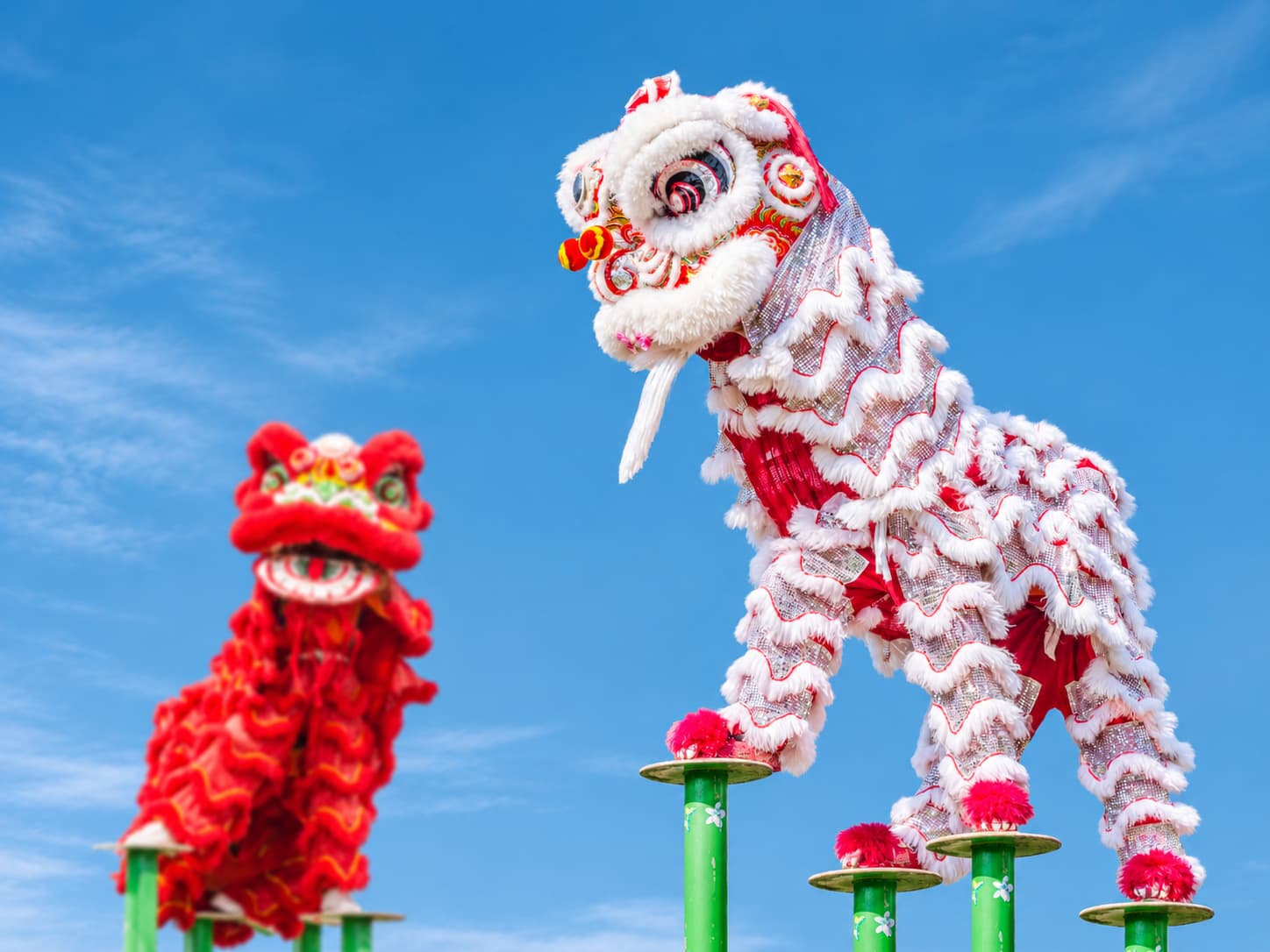
The highlight of the Southern lion: jumps from pole to pole, high above the ground. It takes years of practice, strength and trust between head and tail.

In the classic «cai qing» (采青), the lion «eats» a green vegetable with a red envelope hidden inside and «spits» it out again: a wish for luck and wealth.
A new lion is «awakened» in an eye-dotting ceremony (点睛, diǎn jīng): its eyes are dotted with red paint, and only then does it come to life. In the Southern lion, the colours also have a meaning: according to tradition, yellow, red and black lions stand for the three heroes Liu Bei, Guan Yu and Zhang Fei from the Three Kingdoms period.
Why martial artists dance the lion.
The lion dance and Kung Fu have belonged together for a long time. Traditionally, many Kung Fu schools in southern China had their own lion dance team, and the dancers were often martial arts students. The famous Kung Fu master Wong Fei-hung, for example, was also known as a lion dancer. The reason is simple: the lion dance needs exactly what Kung Fu trains.

This is why the lion dance is a perfect addition to your Shaolin Kung Fu or Wushu training.
What brings the lion and dragon to life.
The head is traditionally made of a light bamboo frame covered with papier-mâché, fur and decorations. The eyes, mouth and ears can move. A long cloth forms the body and tail, and the dancers wear matching trousers and shoes.
A big head and a long body of fabric over hoops, carried on poles by the dancers. The body is divided into sections, and long dragons can be many metres long.
A large drum, a gong and cymbals. The drummer leads the dance: the rhythm tells the dancers when the lion sleeps, wakes up, eats or jumps.
In the first months, you mainly train the basics: stances, steps, stamina and the rhythm. The costume comes later, when the movements sit.
From Chinese New Year to parades around the world.
The most important occasion is Chinese New Year. Lions and dragons dance through the streets, often until the Lantern Festival on the 15th day of the new year. Lion dances are also performed at shop and restaurant openings, weddings and other celebrations, to bring luck and keep bad luck away. Today, the dances are known worldwide: in Chinese communities from London to New York and Sydney, lion and dragon dances are part of every New Year parade, and there are national and international competitions.


Lion dance shows: on the poles, at night and at festivals.
Ready to start your training?
No deposit and no application fee. You only pay after you arrive at the school.
Lion and dragon dance: your questions.
Two traditional Chinese dances performed at festivals. In the lion dance, two dancers bring a lion to life; in the dragon dance, a team carries a long dragon on poles. The lion stands for courage and protection, the dragon for power, luck and prosperity.
A lion is danced by two people, one for the head and one for the tail. A dragon is carried by a whole team on poles. The lion dance is about expression, strength and acrobatics, the dragon dance about teamwork and flowing movements.
One dancer per section of the dragon, plus the pearl bearer. A dragon for performances usually has nine sections or more; long parade dragons need dozens of dancers.
The pearl stands for wisdom, the moon and good fortune. The dragon chases it during the whole dance, led by the pearl bearer.
The dragon dance is usually traced back to the Han dynasty (206 BC to 220 AD), when people danced with dragon figures to ask for rain and a good harvest.
According to the legend of Nian, a monster that attacked villages at New Year was afraid of red, loud noise and light. The noisy lion dance with drums and cymbals is meant to drive away bad luck and bring good fortune for the new year.
Yes. At our Kung Fu school in Henan, you can learn both the lion dance and the dragon dance. We mainly teach the Southern lion and have plum blossom poles on campus.
No. The lion and dragon dance is an interest class that costs nothing extra on top of your all-inclusive price.
No. You start with the basics: stances, steps, stamina and the rhythm of the drum. Kung Fu experience helps, but it is not required.
The lion and dragon dance is difficult. Plan at least three months. The first one to three months are for the basics; after that, you learn the head or the tail of the lion, depending on your level.
The classes are arranged according to the students’ wishes, and a session lasts about one and a half hours. Because our Chinese students practise regularly, you can join at any time.
As you like. International students can practise together with the Chinese students or as their own group.
Yes. Students have the chance to take part in shows and performances, when they are ready.
Shifu Zhang Qi teaches the lion and dragon dance at our school.