
Khan shares his experience training at the Yuntai Mountain School in China.
I had no previous experience in Chinese Kung Fu, but this trip was truly worth it. I learned and experienced a lot during this one-month stay. And I have to say, this place really is a home for martial arts lovers!
Getting started
Before you go, you need to know what you are looking for and what you want to achieve. Here are the three disciplines you can choose to learn during your stay.
Shaolin Kung Fu
If you want to learn Kung Fu techniques with and without weapons, and you are prepared for tough training and stretching, this is exactly what you are looking for!
Sanda
Sanda is a Chinese form of Kung Fu sparring. If you want to learn practical techniques for sparring and self-defence, this is the right choice for you!
Tai Chi
Many young people in China and Hong Kong are starting to learn Tai Chi. It is a slow but powerful form of Chinese Kung Fu and an excellent exercise for your mind, soul and body. You can also apply some Tai Chi techniques in practical sparring situations.
Accommodation
The school at Yuntai Mountain used to be a motel. Therefore, the rooms, beds and even the bathrooms are quite decent. The only downside is that the rooms can be a little dusty when you first move in, so you may need to clean yours before settling in.
As I visited during the off-season, the school did not provide hot water. There were also temporary water cuts during the day to avoid wasting water. (Editor’s note: The water problem has since been fixed. There had been some issues around Chinese New Year.) There is a note in each room, written in Chinese, stating that the tap water is drinkable because it comes from the mountains. However, if you are not comfortable drinking it, you can always buy bottled water. A water dispenser is available, and you can also buy daily necessities and snacks at the shop downstairs. Wireless internet should be available soon. There is no laundry service, so you will need to wash your clothes by hand and hang them on the roof. On sunny days, they dry very quickly. By the way, you can get hot water for drinking and instant noodles in the canteen.
Facilities
There are classrooms, a canteen and a shop inside the school building. Training usually takes place outdoors, with running sessions around the buildings and even up into the mountains. There is an outdoor basketball court and two table tennis tables. Get used to tourist buses coming and going and people watching you train. Down the hill, there is an indoor training centre with various weapons available. It sounds like a great place to train when it is raining or even snowing.
Training
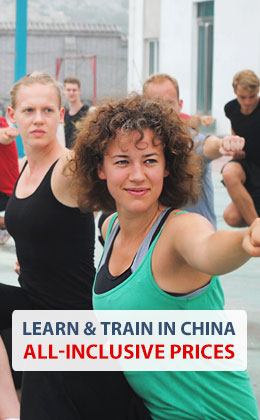
The training is certainly not easy because you will be stretching muscles and areas of your body that you do not normally stretch or use. On the first day, I was so excited that I gave it everything I had. On the second day, I could barely walk, but I continued training. Within one month, I had learned one fist form and one staff form, as well as some basic punches, kicks, stances, jumping kicks and acrobatic movements. Every day, we went jogging and did stretching exercises two to three times. Training started at 6:30 am and finished at 8 pm. We trained five and a half days per week. After just one month of training, I believe my fitness level and flexibility had improved tremendously.
Length of stay
Honestly, one month is just an introduction and a first experience. After three months, you will have learned a more advanced staff and fist form. After six months, you will also learn a basic Dao (knife) form. The Shifu mentioned that within one year you would learn the basics of the four main Shaolin weapons: Gun (staff), Qiang (spear), Dao (knife) and Jian (sword). After that, you can choose whichever weapons you would like to continue learning. If you wish, you can even request specific subjects, and the school will tailor a training programme for you. Once you have learned everything in your programme, you will receive a graduation certificate. However, this requires at least two years of training. You will still receive a certificate for a three-month stay.
Shifus
You might expect the Shifus (masters or instructors) to be monks or something similar. In fact, they are all young people! They started training full-time at the age of 10 and began teaching at around 15 or 16. By the age of 20, they already have a great deal of experience in both martial arts and teaching. Most Shifus speak English fluently. During the training programme, we occasionally switch instructors, which means you receive different advice and learn from different teaching styles. You can always speak openly with the headmaster if you would prefer another instructor or a smaller training group.
Language
I speak both Mandarin and English, so I did not have any communication problems. In fact, I often acted as a translator and even as a Mandarin teacher for the international students. You may not have any problems during the classes, but communicating with other people at the school and especially when visiting the village or city can be rather difficult. Of course, speaking Mandarin is an advantage, but the instructors and the principal are always willing to help if you have communication problems.
Mandarin classes
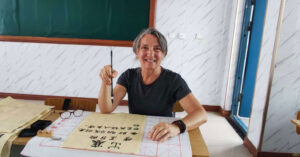
Several times a week, Mandarin classes are offered for international students. You can learn basic spoken Mandarin and recognise some Chinese characters. The aim is to help international students communicate in everyday situations, such as ordering food, expressing themselves and understanding the language commonly used during training. So bring a pen and notebook, and let’s learn some Chinese!
Travelling
Yuntai Mountain is about a one-and-a-half-hour drive from Zhengzhou Airport and Zhengzhou Railway Station. The school is happy to pick you up when you arrive. Just give them your arrival date, time and flight or train number, and they will take care of you. However, you will need to organise your departure yourself. A taxi directly from the school to the airport or railway station costs around RMB 300. If you prefer to travel by bus, it is not very complicated and costs around RMB 50 in total.
Nearest village and city
At the school, you can hire a cab for just RMB 8 to take you to a small nearby village. There you will find places to eat, an internet café, showers, a supermarket, a mobile phone shop and more. You can share a cab with up to four people, and the journey takes around 10 minutes. However, if you want to visit a larger city with shopping malls and restaurants such as McDonald’s, KFC and barbecue lamb restaurants, you will need to go during a half-day or full-day break. A cab costs around RMB 60 each way and can carry a maximum of four people. The journey should take no more than one hour.
Food
The school provides three meals a day. The food mainly consists of congee, rice, Chinese steamed buns, tomatoes with eggs, cucumber and sometimes meat such as chicken, beef and pork. If you are Muslim, the school will provide meals without pork, prepared in a separate kitchen. The food provides enough energy and nutrition for each day, although of course it does not taste as good as steak or McDonald’s.
Preparation
Before you come, I recommend doing plenty of jogging, push-ups, sit-ups and squat thrusts. Otherwise, the training may simply be too hardcore, or you may end up wasting time if you arrive without any preparation. You get out of it what you put into it.
Fees
The monthly fee, including accommodation, three meals a day and training, is US$490.
The school uniform costs an additional US$10 (the summer version might be cheaper, but I’m not sure).
Later, when you start learning weapon forms, you will need to buy your own weapons. A staff costs only RMB 6 (custom-made to match your height!), and a knife costs RMB 15.
School trips are organised from time to time, depending on the destination. My last trip was to Kaifeng, about a four-hour drive away, to visit a temple. Including food, transport, entrance fees for the temple and an amusement park, the total cost was RMB 200 per person. It was certainly fun and well worth it!
Tips
Try to exchange some money into RMB (Chinese currency) as soon as you arrive. Once you reach the school, the only way to get cash is to travel for an hour to the big city to exchange money or borrow some from your fellow students.
If you want to bring your own weapons, such as a staff (the length should reach your eyebrows) or a knife, on the plane, you may want to wrap them carefully and label them as “fragile”. So bring some tape and wrapping material just in case. Bringing them on the train is permitted.
Enjoy your stay and have fun! Top

 France · nearly 6 months

 Germany · 3 months

 Switzerland · 5 weeks
 New Zealand · 3 months